


Enjoying Clare's Christmas
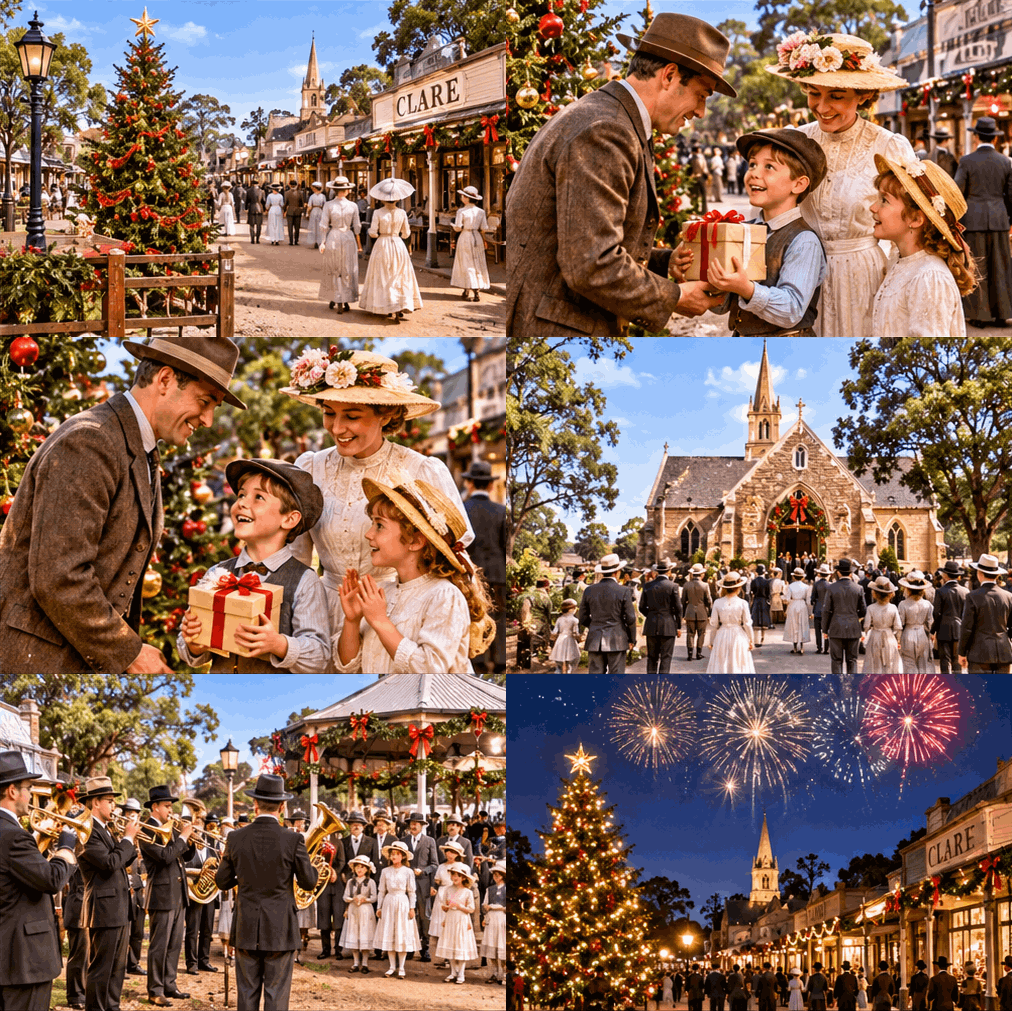
Clare's Christmas celebrations provide a fascinating glimpse into country life in the late 19th and early 20th centuries. Fortunately, the Clare Museum has preserved several contemporary newspaper accounts, including descriptions of Christmas in 1889, 1929, 1931, 1936 and 1949.
One particularly interesting feature is that Christmas in Clare was not necessarily a large organised public celebration. It centred on church services, family gatherings, sporting activities, music and the shops in Main Street.
1. Christmas in Clare – 1889
Contemporary newspaper account:
The Clare Museum reproduced an account entitled Clare's Christmas (1889).
The description gives us a very good picture of the town on Christmas Eve:
Business premises were decorated with flowers, evergreens and Chinese lanterns.
Main Street was crowded with people enjoying the evening.
Local businesses experienced brisk trading.
The weather was calm, cloudless and rather warm.
A well-attended midnight service took place at the Catholic Church.
Christmas Day itself was comparatively quiet.
Church services were held throughout the town, while recreational activities included:
Cricket between the shop boys and boys attending the Sisters of St Joseph's school.
Lawn tennis.
Swimming at the Clare baths.
A musical and literary competition at the Wesleyan Lecture Hall.
The shop boys won their cricket match.
An interesting detail is that the Reverend Albert Stubbs organised the evening entertainment because no other Christmas entertainment had been advertised. Dr Bain opened proceedings with a musical overture.
Clare Museum
2. Christmas Eve in Clare – 1929

By 1929, Christmas Eve had become a more organised community occasion.
The Clare Brass Band, including members of the Pryor family, arranged to play Christmas carols and other music in Main Street.

Approximately 14 musicians were expected to participate, under the direction of deputy bandmaster Reverend A. H. Kenner.
A particularly interesting detail is where they intended to play:
Opposite Bentley's Hotel.
Outside Pappin's Garage.
Near the Town Hall.
A local businessman, Mr A. Knappstein, lent his motor lorry to assist the arrangements.
The band intended to continue playing until 11 or 11.30 pm, even after the shops closed.

3. Christmas Carnival – 1931
Christmas was increasingly becoming an occasion for attracting visitors to Clare.
The 1931 newspaper account describes:
Bowling tournaments.
Swimming at the local pool.
Visitors travelling by motor car through the hills.
Excursions to Sevenhill College.
Hospitality provided by local residents.
The bowling tournaments attracted competitors from outside the district.
4. Christmas celebrations – 1936–1949
By the late 1930s and 1940s, sporting activities were an important part of the Christmas holiday period.
Some examples:
Year | Christmas activity |
1936 | Clare Croquet Club Christmas tournament |
1937 | Poem entitled Christmas at Clare by Mrs F. L. Sanders |
1949 | Christmas swimming carnival at Clare Pool |

The 1949 swimming carnival included 13 events, with men's and women's Mid-North championships. A dance was also arranged for the evening.

5. Christmas in the Clare Valley landscape
One of the most evocative historical records is Mrs F. L. Sanders' 1937 poem, Christmas at Clare.
It describes a very different Christmas landscape from the traditional English Christmas:
The poem mentions:
Ripening apricots.
Bottlebrush flowering in the summer heat.
Hollyhocks in cottage gardens.
Cicadas and parakeets.
Dry riverbeds and surrounding wheat fields.
The Christmas bush flowering in the hills.
It provides a lovely contemporary description of how residents experienced Christmas in the South Australian countryside.

A CHRISTMAS HOLIDAY IN CLARE (1936)
My wife and I spent five days in Clare;
We came away with desire to live there,
As I from asthma was quite free,
During whole time, which went merrily.
We spent many hours at the Bowling Green,

Watching the games amidst lovely scene;
Hills well wooded both near and far.
To us old Clare is a shining star.
I wonder more folk from Adelaide Do not visit Clare,
who money have, made,
As it is like a country shopping city,
With well-stocked windows and very pretty.
On New Year's Day in the afternoon,
We sat on seats in shade that was a boon,
Watching cricket match which was not tame. . .
For who-ere they were, played a very good game.

Big hitting was frequent; oft ball to fence went,
The fielding was smart, as keen as scent,
I feel it my duty to boost up Clare
Intending again to spend a holiday there.
The town is supplied with electric light,
So out-door games are played at night.
One thing needed is deep drainage, I thought;
Which would sure help more homes to be bought.
Another need is the naming of the Streets,
Then one would know the streets one meets,
Another is a reservoir water supply,
But these three may appear before I die.
Poem: Christmas At Clare (1937).
The bottle-brush glows like an altar light's flame,

And the apricots ripen and fill,
Goldenly gleaming 'neath skies of high noon,
Like the gardens of old-time Seville.
From the dome of St. Michael's the Angelus falls,
'Cross the whispering song of its pines,
And afar Wolta Wolta lies wrapped in the trees,
Girt by stretch of brown grass and green vines.
Gay holly hocks flame above picket and hedge,
And the seeded pods crack eerily,
While cicadas shriek and the parakeets scream
'Gainst the pink of a tamarisk tree.
And a whirr of wild wings cleaves the gum-shaded air

'Bove the river-bed stony and dry,
(Near the Stepping Stones set by our fathers of yore),
While the northwardbound traffic rolls by.
There's dust to the east where the Hill River wheat
'Mid the thrum of the thresher falls low—
'Gainst the olive's dull green its golden spears gleam,
While the hay lorries ply to and fro;
And the Christmas Bush whitely gleams out in the hills
Shedding fragrance—like incense —afar,
While the anthem-filled breezes that eddying pass,
Breathe the spirit of Manger and Star.
1. The development of Christmas in Clare
Period | Historical setting |
1860–1869 | Growing farming settlement, churches and early commercial development |
1870–1879 | Expansion of the township, railway connections and local businesses |
1880–1889 | Established community with sporting clubs, churches and social organisations |
1890–1900 | More organised public recreation, school celebrations and community events |
By 1869 Clare had its own newspaper, and by 1871 the township had a population of just over 1,000.
2. Christmas traditions - Church celebrations
Churches were likely to have been central to Christmas in Clare.
Particularly important institutions to investigate include:
Catholic Church at Clare.
Jesuit community at Sevenhill.
Wesleyan Methodist Church.
Church of England.
Church communities around Polish Hill River.
Christmas services, Sunday school celebrations, carols and children's gatherings are likely to feature in the newspaper reports.
Christmas at the large properties
Large pastoral properties offer another interesting avenue.
Properties worth investigating include:
Martindale Hall.
Bungaree Station.
Spring Farm and other established farming estates.
Christmas gatherings on these properties involved employees, families, visitors and neighbouring landholders. Specific celebrations will need confirmation from contemporary records.

3. A contemporary example: 1889
We have an unusually detailed account of Christmas 1889, reproduced by Clare Museum.
It records:
Christmas Eve decorations and Chinese lanterns.
Crowds walking along Main Street.
Strong Christmas trading.
Midnight Catholic Mass.
Christmas cricket on the Oval.
Swimming at Clare Baths.
A musical competition organised by Reverend Albert Stubbs.
Clare's Christmas (1889)
Christmas Eve in Clare passed off satisfactorily. Some of the business places were decked with flowers, evergreens, and Chinese lanterns, and Main street presented a most animated appearance.
It is years since we saw such a large number of happy people promenading the thoroughfare. The business people did a thriving trade.
The night was calm and cloudless and very pleasant, though rather warm.
An impressive midnight service was held in the Catholic Church, and it was well attended.
CHRISTMAS DAY (1889). Christmas Day, as is customary in Clare, was unattended with any special demonstration, with the exception of the musical and literary competition in the Wesleyan Lecture Hall.
Services were held in most of the churches, and appropriate discourses delivered.
The day was very hot and oppressive.
A cricket match was played on the Oval between the shop-boys and the lads attending the Sisters of St. Joseph' school, while some of the adults practised vigorously.
The shop-boys won their their match.
Lawn tennis was indulged in by a few enthusiasts, and the Clare baths were well patronised.
1889 - MUSICAL AND LITERARY COMPETITION.
There being no amusement of any kind advertised for Christmas evening, the Reverend Albert Stubbs stepped into the breach and conceived the happy idea of having a young people's musical and literary competition, which took place in the Wesleyan Lecture Hall.
Dr. Bain started the proceedings by playing an overture.
Mr. W. Kelly, J.P. (Mayor), occupied the chair, and in a happy, practical, and humorous address commended Mr. Stubbs for his push and energy in initiating the affair.
There were five competitors for solo music — Misses F. Beckmann, L. Stubbs, L. Carrigg, D. Saunders, and F. Saunders.
All the young ladies played very nicely indeed, and the judges (Miss Smith, Mrs. Hodge, and Dr. Bain) awarded Miss F. Saunders first honors, the piece she played being ' The Last Waltz,' by Tito Mattei.
Christmas and the Holidays at Clare (1923).
Saturday, December 23, was one of the worst days experienced in Clare for some years.
A strong northerly gale raised clouds of dust, and it was not until about four o'clock in the afternoon that the wind lolled, end better conditions prevailed.
From then on into the evening residents of the outlying districts steadily made their way into the town, and by 8 o'clock Main street was well filled by a throng of happy people, the children making night hideous with the usual instruments of ear torture dear to them.
The business places did good business during the evening, in many establishments the proprietors being hard pushed to keep up with the demand for their wares.
About 10 o' clock the gale commenced again, and soon all dispersed to their homes.
Sunday, the 24th, was a nice day, but on Christmas Day rain commenced to fall, and continued intermittently throughout Tuesday.
This prevented outdoor games and sports of any kind, and the sports in connection with the City Athletic and Cycling Club had to be postponed.
This was a great pity, as a special train from Adelaide was well filled, end numbers of people from the surrounding districts came into the town for the occasion.

The track on the oval was unfit to ride races upon, and the committee had reluctantly to postpone the sports.
The Blyth Brass Band, which had been engaged for the occasion, played a number of selections on the balcony of the Clare hotel during the afternoon, and the music was much appreciated by the listening crowd.


Comments