


Open Sundays/Public Holidays 10.00 am to 3.00 pm
Easter Sunday from 10.00 am to 1.00 pm – then by appointment until 4.00 pm (ring Pauline 0400 010 879)
Hello
Charles Kimber
Charles Kimber (15 January 1826 – 29 August 1913) was an English-born Australian orchardist, flour miller, and politician who played a role in the development of colonial South Australia.
He combined agricultural enterprise with public service and is remembered as a representative of the Clare district during the late nineteenth century.


His Story
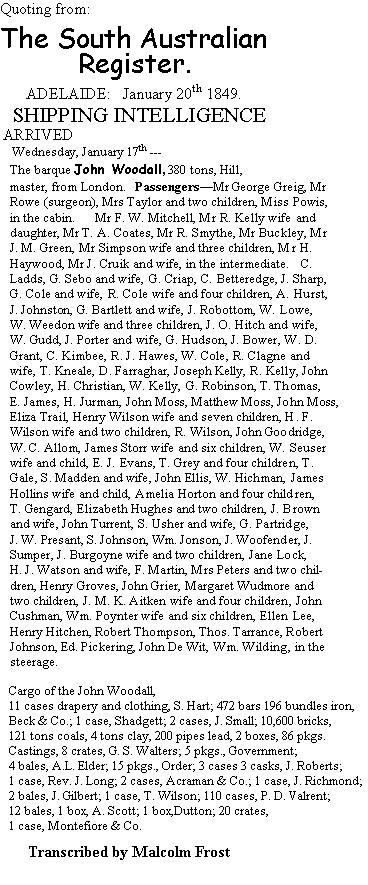
Charles Kimber was born in Newbury, Berkshire, and arrived in South Australia on the John Woodhall on 5 January 1849.
He began as a storekeeper in Burra, then on Yorke Peninsula, and also tried farming in the vicinity of Mintaro.
He moved to the Clare district, planting currant vines, which became a sizeable industry.
In 1864 he took over Frederick Hannaford's flour mill in Clare, where the Town Hall was later built.
In 1877 he leased it to Alfred Palmer and moved to Kadina to run that mill, returning to Clare in 1881 to run the mill in partnership with his sons Henry and Richard,[1] later largely destroyed by fire,[2] and Riverton, later run by his son, Charles Kimber Jr.
He was at one time Chairman of the Clare District Council, Mayor of Clare, a member of the North Midland Road Board, a member of the Education Board of Advice, and a member of the Clare Licensing Bench.
He was elected to the South Australian House of Assembly seat of Stanley, which he held from April 1887 to April 1890.[3]

.avif)
History of Charles Kimber
Mr. Kimber was born at Newbury, Berkshire. England, on January 13. 1826, and as a lad entered the wholesale stationery warehouse of Mr. James Morris, Upper Thames street. London.
After obtaining seven years' valuable business experience he, being a young man full of enterprise, determined to seek his fortunes in America.
Had he been successful in obtaining a boat to cross the Atlantic the valuable farming land around Gladstone and Georgetown would probably have been still in the hands of the squatters, and the average yearly wheat yield of South Australia would be much lower than it is.
Being unable to secure a berth to America he embarked on the barque John Woodhall, and arrived in South Australia on January 5, 1849.
Mr. Kimber first obtained employment. with Messrs. Acerman, Cooke, and Co., of Flinders street, but left them after a few months to proceed to the Burra, where he was engaged by the Patent Copper Company, and where he also met his future wife, Maria Nankervis (born c. 1834
– 17 September 1925) on 16 September 1852; their home was "Woodleigh", Clare.
After being married at St. Mark's Church, Penwortham, he and Mrs. Kimber proceeded to Melbourne, and spent their honeymoon on the Forest Range digging. (Other sources say they married in Adelaide.)
Not being successful as a miner he returned to the Burra, and commenced business for himself at Redruth.
This venture being highly profitable he purchased a farm on the Wakefield River, near Mintaro, where he remained for five years.

Modern Woodleigh
A few years ago Mr. Kimber retired from business, and went to live at Glenelg but the call of the land was too strong, and he has now returned to Clare to employ his still active brain in assisting his youngest son to plant a large orchard and vineyard.
Of Mr. Kimber's seven sons, five are owners of valuable fruitgrowing properties—
-
Mr. H. Kimber, ol Athelston:
-
Mr. A. Kimber, of Armadale, Western Australia: and
-
Messrs. W., and M., and. J. Kimber. of Clare.
-
The other two sons are Mr. C. Kimber. of Adelaide, and Mr. R. Kimber, of Port Pirie.
-
there are three married daughters—Mrs. W. Rusell Evans, of Melbourne:
-
Mrs. A. Roberts, of Kookynie: and Mrs. F. W. Wheatley. of Adelaide:
-
and 43 grandchildren and two great-grandchildren. On Tuesday last, at the invitation of all their children. Mr. and Mrs. Kimber were entertained at dinner at the residence of one of the sons at Clare.
Their family consisted of eight sons and three daughters, the survivors of whom are
-
Messrs. Richard Kimber, (of New South Wales), Henry, (of Adelaide), William, (of Victoria), Maddern, (of Clare), Alfred, (of West Australia) and James, (of Clare),
-
Mrs. R. Evans (of Victoria), Mrs. A. Roberts, (of Clare), and Mrs. Wheatley, (of New South Wales).


Saturday 4 October 1902, page 22
Mr. and Mrs. Kimber are colonists of 63 years
Mr. Charles Kimber celebrated his golden wedding at Clare on Tuesday. September 16, 1902 having been married on September 16. 1852, to Miss Nankervis, of the Burra.
Both Mr. and Mrs. Kimber are in the enjoyment of full health and vitality, and give every promise of living to a grand old age.
Saturday 28 September 1912, page 41
DIAMOND WEDDING
On Monday, September 16, Mr. and Mrs. Charles Kimber celebrated their diamond wedding at Clare, where they have resided almost continually for the past 48 years.
On November 15th 1895 (when Charles was nearly 70) all Charles' properties, including his beloved "Woodleigh" were put up for auction. I wonder if he felt bereft when they were sold?
At that time Charles owned the Clare Flour Mill and mill house, 4 stone shops, 4 stone cottages, "Woodleigh", "Hollands" (Section 48), Riverton Flour Mill, plus a variety of equipment and furniture.
After the sale, Charles, Maria and some, at least, of the children, moved to Adelaide where they lived for a time at Gover Street, North Adelaide (on north side, 3rd house east of Jeffcott Street between numbers 224 (Ladies School) and 234; now a block of units).
He and Maria had one or two holidays, including a trip by ship to Western Australia to see their son, Alfred Ernest, who had gone to the goldfields a few years earlier. By then Alfred was fruit growing near Armadale. Charles gave him money to build a house so that he could marry.
On his return to South Australia Charles and Maria moved to a house in Augusta Street, Glenelg. It was a seven-roomed stone house belonging to Mrs Rose Birks, on Lot 45, on Torrens Square (North-west corner of Augusta Street and Waterloo Street, and one of four similar houses, still standing today). Charles and Maria called the house "St Madron's".
It was from this house that the youngest daughter, Alice, was married on 28.6.1898. Charles' son, Richard, was also living in Glenelg for some of this time, and running a grocer's shop on Jetty Road. The house was very close to St Peters Anglican Church and Charles' and Richard's families attended there each Sunday.
Charles missed Clare, however, although Maria did not. He also missed the interest that the management of a property brings. In April 1899 Charles purchased from Mr P. Gillen two 80-acre sections Nos. 1958 and 1966 near Armagh, west of Clare.
Business
After a brief space at water distilling at the newly discovered Wallaroo Mines, Mr. Kimber purchased the mill at Clare, which was at that time the most important centre north of Adelaide.
His thorough knowledge of business and high personal integrity soon made him a man of standing in Clare, and he became one of the most flourishing merchants of the north.
His milling business was further extended by branches at Kadina and Riverton.
After the disastrous fire in the Clare mill Mr. Kimber returned to his old love—the land, and planted an orchard at Woodleigh, two miles out of Clare, being thus one of the pioneer fruitgrowers of the district.

It did not take long for Charles to become one of a group of men often referred to as the “elite” of Clare.
Charles was perhaps lucky, perhaps had good judgement, as he arrived in Clare when the district was reaching the peak of its prosperity.
Farming was expanding into the northern areas, rainfall was good and crops excellent, bringing much business to his mill, which was a very busy centre of activity in the town - and was also the building with the highest assessment of any in Clare.
In 1869 Charles had 50,000-60,000 bushels of wheat in storage at the mill and in 1883 Charles employed 40 hands at the mill, making him probably the largest employer of labour in the area.
During this prosperous period of Clare's history, Charles took part in many movements and activities. He was treasurer (1869), and later (1874) Vice-President, then President of the Clare Agricultural and Horticultural Society, a society formed to boost the enthusiasm and to further the interest of the farmers and fruit growers of the areas.
Later as mayor, Charles also chaired public meetings to consider the provision of a new school and subsequent appointment of a suitable teacher.
Some of the older Kimber boys (probably Henry and Richard) attended the Clare Grammar School. This private school, set up in 1870, catered for 20 to 30 older boys and taught Latin and French in addition to standard subjects, for a fee of 10 guineas per year.
Charles was appointed Justice of the Peace in 1870, an honour in those days as only highly respected men of good position were so appointed. As J.P. he also, on a few occasions, sat on the bench as magistrate.
In 1872 Charles was unanimously elected mayor and held that office for two consecutive terms (1872 and 1873) and a later term in 1880.
When Charles first consented to stand for Mayor the Northern Argus wrote "he will of course be elected as no other man in Clare has the slightest chance of success in opposing him".
After Charles had refused re-election in 1880, the then mayor said, "As Councillors they highly respected Mr
Kimber, He had been so thoroughly upright, open and courteous that they felt it was indeed a privilege to
meet with him in the Council Chambers".
Charles was director of the company set up to control the Town Hall (foundation stone laid in 1865); and vice-President of the Mechanics Institute.
Charles Kimber's success as a flour miller enabled him to acquire substantial land holdings in and around Clare.
As his milling business expanded, he invested in farming properties which supplied grain to the mill while also providing additional sources of income.
The properties were progressively improved through cultivation, fencing, water development and the construction of farm buildings. These improvements reflected Kimber's belief in careful management and long-term investment rather than speculation.
His ownership of both agricultural land and milling facilities created an integrated enterprise in which wheat could be grown, purchased from neighbouring farmers, milled locally, and marketed throughout the district.
This arrangement strengthened both his business and the local agricultural economy.
Like many successful nineteenth-century businessmen, Kimber regarded land ownership as an important measure of financial security.
Over time he accumulated a significant portfolio of rural and town property, much of which later passed to members of his family.
The prosperity generated by these investments enabled Charles and Maria Kimber to provide comfortably for their large family while maintaining one of the district's prominent homes.
The Kimber properties remained closely associated with the family for many years, and several descendants continued farming and business interests established by Charles. His careful acquisition and management of land formed an important part of the legacy he left to later generations.
This text is copied from the Kimber Family History "The Kimbers of Clare: Charles and Maria Kimber", by Pamela McCallum, 1989.
Charles loved the land, as many of his forebears had done, and at least some of his business activity was directed towards the fulfillment of his ambition to work the land.
He experimented a great deal on his property, concentrating largely on the growing of fruit for which “Woodleigh” was ideally situated.
It lay partly on fertile river flats, partly on a low hill slope and was well-watered. Charles was amongst the first to try fruit growing rather than cereal growing in the area and was certainly the first to grow currant vines.
Again family rumour suggest that Charles made a trip home to Europe to buy suitable cuttings from France and Spain. This was probably during the mid 1870s. His grandson, Spenser, could remember Charles calling one of his sons to go out and get cuttings of currant vines ready to send to the Chaffey Brothers in Mildura.
There is no proof of this but Charles approved of the Chaffeys' efforts to establish an irrigation settlement in 1887 so that the story is not improbable.
Robert Noye in his book, "Clare: a district history" wrote, "By 1892 ... a hundred thousand rooted vines were ready in the Clare nursery beds, mostly the Zante currant and other drying kinds, the vine grapes being treated with a measure of caution.
Messrs Kimber” (William and Madron) "received large orders for the Muscatel and Doradillo, said to be suitable for export and large consignments of cuttings were sent to Mildura and Renmark."
Charles also introduced the commercial growing of orange trees and, in 1886, was commended for his use of irrigation in the growing of his orange trees.
There is a description of "Woodleigh” in the Northern Argus, February 7th 1896 in an article entitled, “Amongst the Vineyards and Orchards. " This was one of a series of articles by “Uno” written as part of a campaign to promote fruit growing in the district.
"Woodleigh" was described as, “one of the most valuable properties in the district" producing a wide variety of fruit.
The notice of sale in the Northern Argus, November 15th 1895 lists the fruit trees as follows: "1,000 Apples, 300 Pears, over 2,000 Plums, 150 figs, 1.5 acres Quinces, 5 acres Apricots, 1 acre Peaches, 4 acres Vines, Oranges and a number of Cherries and Walnuts. The soil is a rich, deep, black loam of the most fertile description capable of growing any kinds of its or lucerne."
This property Charles bought in 1870 and he spent much of the next few years establishing it. He leased the mill to Mr Alfred Palmer from 1874 to 1878, none of his sons by then being old enough to manage it. (John, aged 20, was in Kadina). It was during this time that Charles paid his probable first visit to Europe to buy vine cuttings.
At this time Charles also had another project under way for he and his friend, Francis Treloar of Watervale, had taken out an option on land near Streaky Bay.
In 1875 Francis, Charles and Charles junior (aged 19) went by ship to Streaky Bay and hence by horse to view the land, which they discovered to be very dry and barren with no permanent water. They had an enjoyable jaunt but decided against taking up the option.
By 1879-80 Charles had planted his vine cuttings and was extending the orchard.
On 15th October 1881 he purchased the 77 acre Section, No. 49, later called "Chatswood" and Section 48, known as “Hollands”, and his two sons, William and Maddern later began fruit growing there.
Those sections were also on the Stanley Flat Road on the same stretch of fertile land, and separated from "Woodleigh" by only one section. Charles sold "Chatswood" to William and Maddern on 13th May 1892 but retained "Holland".
When Charles' first four sons were old enough to undertake the management of the mills and had worked under supervision for a suitable period, in 1883, Charles formed a partnership, Charles Kimber and Sons with Charles junior, Henry and Richard as partners.
John was by this time established in partnership with Mr. Drew at the Kadina mill.
The Clare partnership probably established to ensure the proper running of the mills whilst Charles was overseas lasted only about four years as in 1887 it was decided that Charles junior would manage the Riverton mill (bought 1880) on his own, and Henry and Richard would manage the Clare mill.
Charles Kimber senior remained the owner of the mill but lived thereafter in semi-retirement at “Woodleigh". He was then 64 years old.
In 1886 Charles decided to build a new mill beside the old one and to equip it with the most up-to-date roller mill machinery. The old mill, with its giant acacia tree reaching almost to the top storey, was very shabby and its equipment not as efficient as modem machinery.
The building of the mill also provided much-needed jobs in the town. An article "Links with the Past: Burning down of the Clare Flour Mill 51 years ago", published in the Northern Argus on November 7th 1941, describes the building of the mill.
Tom Stafford and John O'Neil, quarried all the stone from the top of Blight's quarry.
Charley Eames and "The Old Pioneer" carted the stone and sand and burnt the lime at "Chatswood" where W. and M. Kimber were gardening at Stanley Flat
... The contractor for the whole of the very fine woodwork was August Paetke ... the iron work for the mill was the work of Gilbert's of Riverton ... The roller mill turned out 5 to 6 bags of flour per hour.
A wheat-dressing plant was in the old section which did not have to be rebuilt. The only addition was a 15 ton fly wheel. The old-fashioned grind-stones were taken out when the new plant was installed. Those flat stones can be seen lying about somewhere on the Clare Soldiers' Memorial Park today.”

Kimber Family
Charles Kimber was born in Newbury, Berkshire, and arrived in South Australia on the John Woodhall on 5 January 1849.
He began as a storekeeper in Burra, then on Yorke Peninsula, and also tried farming in the vicinity of Mintaro.
He moved to the Clare district, planting currant vines, which became a sizeable industry.
In 1864 he took over Frederick Hannaford's flour mill in Clare, where the Town Hall was later built.
In 1877 he leased it to Alfred Palmer and moved to Kadina to run that mill, returning to Clare in 1881 to run the mill in partnership with his sons Henry and Richard,[1] later largely destroyed by fire,[2] and Riverton, later run by his son, Charles Kimber Jr.
He was at one time Chairman of the Clare District Council, Mayor of Clare, a member of the North Midland Road Board, a member of the Education Board of Advice, and a member of the Clare Licensing Bench.
He was elected to the South Australian House of Assembly seat of Stanley, which he held from April 1887 to April 1890.[3]

Politician
In 1887 Mr. Kimber was persuaded to stand for Parliament, and was returned for Stanley with Mr. E. W. Hawker.
Although not a brilliant speaker, Mr. Kimber was known and respected in the House for his high principles and his keen insight into all questions affecting the land.
Having learnt during one recess that the leases of the runs in the country now known as the Northern Areas had run out he, at his own expense drove two of the members about the district for a month, and obtained a large requisition praying that the land should not be re-let, but should be cut up for closer settlement.
This resulted in the opening up of the areas and the laying out of the town of Gladstone.
Although asked to stand again at the end of his term Mr. Kimber declined the honour, but still continued to do good public work in Clare.
He sat for three years as Chairman of the district council and for two years as Mayor.
He also held the post of Commissioner of Roads, and as a justice of the peace sat for many years as Chairman of the Clare Licensing Bench.
Gladstone, South Australia (209 km north of Adelaide) is a classic 19th-century railway town. It uniquely evolved from two separate settlements physically divided by the historic railway line: [1, 2, 3, 4, 5]
-
The Government Town: Laid out as Booyoolie on the western side in 1875. Both towns officially merged under the single name "Gladstone" in 1940. [1]
-
The Original Private Town: Laid out by Matthew Moorhouse in 1872 on the eastern side of the tracks, Section 31, Hundred of Yangya.
Core Town Layout
Gladstone features a classic railway-town layout. [1]
-
Main Street Parallel to the Railway: The primary commercial strip and its principal hotels, banks, and historic sandstone buildings cluster along the main road (Gladstone Street/Horrocks Highway). [1, 2, 3, 4]
-
East vs. West: The western side of town was primarily developed from the former Booyoolie settlement, historically surrounded by farmland. [1]
-
The Rail Hub: The original railway precinct is a major focal point, famous for convening three different railway gauges (narrow, standard, and broad).


Death
THE LATE ME. CHARLES KIMBER. Tragic End.
Monday 1 September 1913:
Much regret is felt by residents here at the tragic death of Mr. Charles Kimber, one of the oldest and best known men of the district (writes our Clare correspondent).
Mr.Kimber was 88 years of age, and lately had been suffering intense agony. Frequently during the past month he had wished that his time could, not bear the pain.
On Friday he ended his sufferings by strangling himself with the string, from his pyjamas. The matter was reported to Mr. J. Bentley, who deemed an inquest unnecessary.
Great sympathy is felt for the widow and family.
The late Mr. Kimber was one of the identities of the lower north, and one of the oldest residents of Clare.
He was a well-read man, and a public-spirited citizen.
He arrived in South Australia by the ship John Woodhall on January 5, 1849, and began as a storekeeper at Burra.
Subsequently, he followed the same business on Yorke's Peninsula. He was also a farmer for some time in the vicinity of Mintaro.
Deceased, who was a large fruitgrower, planted the first currant vines in the Clare district.
He conducted flourmills at Kadina, Clare, and Riverton.
He was at one time Chairman of the Clare District Council, Mayor of Clare, a member of the North Midland Road Board, a member of the Education Board of Advice, and a member of the Clare Licensing Bench.
He sat in the House of Assembly for the old district of Stanley, having been elected to that constituency in 1887.


Read More
-
Wikipedia: Charles Kimber
-
MR. CHARLES KIMBER: Golden Wedding Sat 4 Oct 1902
-
(Family History) THE KIMBERS OF CLARE, Charles and Maria Kimber, by Pamela McCallum, Softcover, 156 pages, library copy held by Clare Regional History Group.